| Year | 1,000,000 AD |
| Event | DCU federal election |
| Frequency | Quadrennial |
| Key issues | Continued rapid development • Environmental sustainability • Rights of diverse posthuman and alien populations |
| Participants | Quintillions of sapient beings across thousands of worlds |
| Significance | A milestone in the DCU's unparalleled history of technological, scientific, and social progress |
| Voting method | Advanced neural-digital voting interfaces |
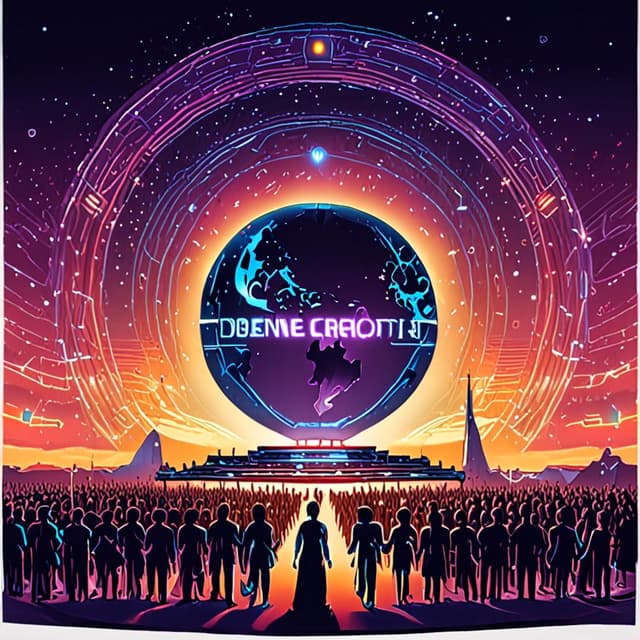
In the year 1,000,000 AD, the Democratic Civilisation Union (DCU) - the vast interstellar federal government that has united the peoples of Earth, the Solar System, and hundreds of extrasolar colonies across the Milky Way galaxy - holds its quadrennial federal election. This landmark event, the 250,000th such election in the DCU's unparalleled history, will determine the leadership of the government for the next four centuries and chart the course for the continued development and expansion of the DCU's dominion.
The origins of the DCU trace back to the early 22nd century, when the first permanent human colonies were established on the Moon, Mars, and throughout the Solar System. As these disparate settlements grew and diversified, the need for a coordinated global government became clear. In 2148, the United Nations was reformed into the Democratic Civilisation Union, tasked with overseeing the political, economic, and scientific unification of humanity.
Over the following millennia, the DCU's mandate expanded as humanity's technological capabilities advanced. Wave after wave of breakthroughs in fields like nanotechnology, terraforming, matter replication, and interstellar travel enabled the colonization of thousands of exoplanets across hundreds of star systems. Today, the DCU's territory encompasses trillions of sapient beings of myriad species, from genetically-engineered posthumans to enigmatic alien civilizations, all united under a common framework of law, trade, and scientific advancement.
The DCU's electoral system has evolved dramatically from its 20th century predecessors. Rather than a single centralized government, the DCU is a vast federal structure with a directly-elected President, a bicameral Congress, and a network of local and regional autonomous governments. Elections are held every four centuries, with citizens casting their votes through advanced neural-digital interfaces linked to the DCU's omnipresent computational infrastructure.
Campaigns are waged not through traditional rallies and advertisements, but through vast distributed networks of virtual town halls, AI-moderated debates, and immersive simulations that allow voters to experience the potential impacts of policies firsthand. Major political parties have given way to dynamic "policy coalitions" that coalesce and evolve throughout the campaign season, their platforms shaped by direct citizen input and the recommendations of powerful AI advisors.
This election cycle's dominant issues reflect the complex challenges facing the DCU as it approaches its second millennium of existence. Foremost is the question of balancing continued technological and economic development with the need for environmental sustainability and the preservation of natural and cultural diversity. Critics argue that the DCU's relentless expansion has come at an unacceptable cost, pointing to the devastation of countless ecosystems and the assimilation or extinction of countless alien civilizations.
Another major point of contention is the DCU's treatment of its posthuman and alien populations. As genetic engineering, cybernetic augmentation, and digital consciousness have become commonplace, the DCU has grappled with how to define and protect the rights of entities that exist beyond traditional biological boundaries. Hardline factions demand a return to "pure" humanity, while others advocate for the full political and social integration of all sapient entities.
Underlying these debates is a fundamental question of the DCU's purpose and the ultimate fate of the civilizations under its stewardship. Should the focus remain on endless material progress and the conquest of the stars? Or should the emphasis shift to a more holistic, sustainable model of development that safeguards the DCU's rich diversity? The outcome of this election will shape the DCU's trajectory for centuries to come.
As the citizens of the DCU's myriad worlds cast their votes through the neural-digital interface, they know the gravity of their choice. This election will not only select the next generation of DCU leadership, but will also determine the fundamental priorities and values that will guide humanity's continued expansion into the cosmos. Will the DCU press onward in its quest for technological supremacy, or will it find a new path centered on harmony, sustainability, and the preservation of all sentient life? The future of a million worlds hangs in the balance.
